

PrecisionBiotics Conference Highlights
Munich, 10–13 October 2026
By Karolina Tykwinska, PhD, Regional Science Lead
Where scientific discovery meets clinical relevance.
In October 2026, we attended the 39th ECNP Congress in Munich, Europe’s leading meeting for neuroscience and psychiatry professionals. In this post, I share my perspective on the congress and what we heard from clinicians at our booth, followed by three scientific highlights: Prof. Kay Tye on social homeostasis and the neuroscience of FOMO, Prof. Julia Sacher on hormonal transitions and women’s brain health, and a campfire discussion with Ziv Ben-Zion on whether AI can be “traumatized”.
This was our first time at ECNP, so we arrived without knowing quite what to expect. What we found was a busy, vibrant congress, with full halls, a packed programme and a constant buzz between sessions.
Explore this issue's highlights
My colleague Abbie Alston and I went with one main goal: to talk with clinicians. We wanted to hear how psychiatrists and neurologists see probiotics and psychobiotics in everyday practice, and whether they see a place for them at all.
We spent many hours at the PrecisionBiotics booth, and the conversations were lively, open and often surprising. To all of you who stopped by our booth: thank you for being generous with your time and your views! We learned a great deal.
Some psychiatrists told us they already recommend probiotics, mostly for patients with gut complaints such as IBS. Others said their patients ask for more “natural” options, or are reluctant to start antidepressants. A few described patients with mild depression or a first episode. Here the benefit-risk balance of medication is not clear-cut, yet the patient still expects to leave with a plan.
What struck me most is that this interest was not reflected in the programme. The microbiome came up often in the talks, but mainly as a mechanism and rarely as something clinicians can act on. So with those conversations in mind, here are my notes from the sessions.
ECNP 2026: three scientific highlights
- Why Missing Out Hurts: What Kay Tye’s Lecture Taught Me About Social Connection
- Timing Matters: What Julia Sacher’s Lecture Taught Me About Hormones and the Brain
- Campfire Discussion: Can AI Be “Traumatized”?
01
Why Missing Out Hurts: What Kay Tye’s Lecture Taught Me About Social Connection
ECNP 2026, Munich
Why Missing Out Hurts: What Kay Tye’s Lecture Taught Me About Social Connection
ECNP 2026, Munich
We all know homeostasis: the body’s ability to keep key variables, such as temperature, blood glucose or hydration, within a healthy range. But did you know there is also social homeostasis?
At ECNP 2026, Prof. Kay Tye showed that our bodies regulate how much social contact we need. It was one of the most inspiring talks I attended, and it changed how I think about loneliness.
Homeostasis, but for people
Think of it as a thermostat for relationships. When we do not get enough social contact, we correct it: we text a friend or go out. But if the shortfall lasts too long, the system fails and we can become ill. Like hunger or thirst, loneliness can make us sick.
The consequences reach well beyond mood. Social isolation and loneliness are linked to mood disorders, but also to heart disease, inflammation, cancer and a shorter lifespan1. Kay even suggested that many personality disorders may be seen as, or derive from, misregulated social connection.
How does the brain sense isolation?
So how does the brain notice that it is running low on company? Part of the answer lies in dopamine neurons in the dorsal raphe nucleus (DRN), which respond to acute isolation. They project to several brain areas, and each adds its own flavour to how we feel and act: exploration, prosocial behaviour or aversion2.
Humans seem to work in a similar way. After 10 hours of isolation, midbrain regions responded to social cues much as they responded to food cues after fasting, and the response tracked self-reported craving3. After isolation, the brain responds to a social cue like a hungry brain responds to food.
The novel part: FOMO
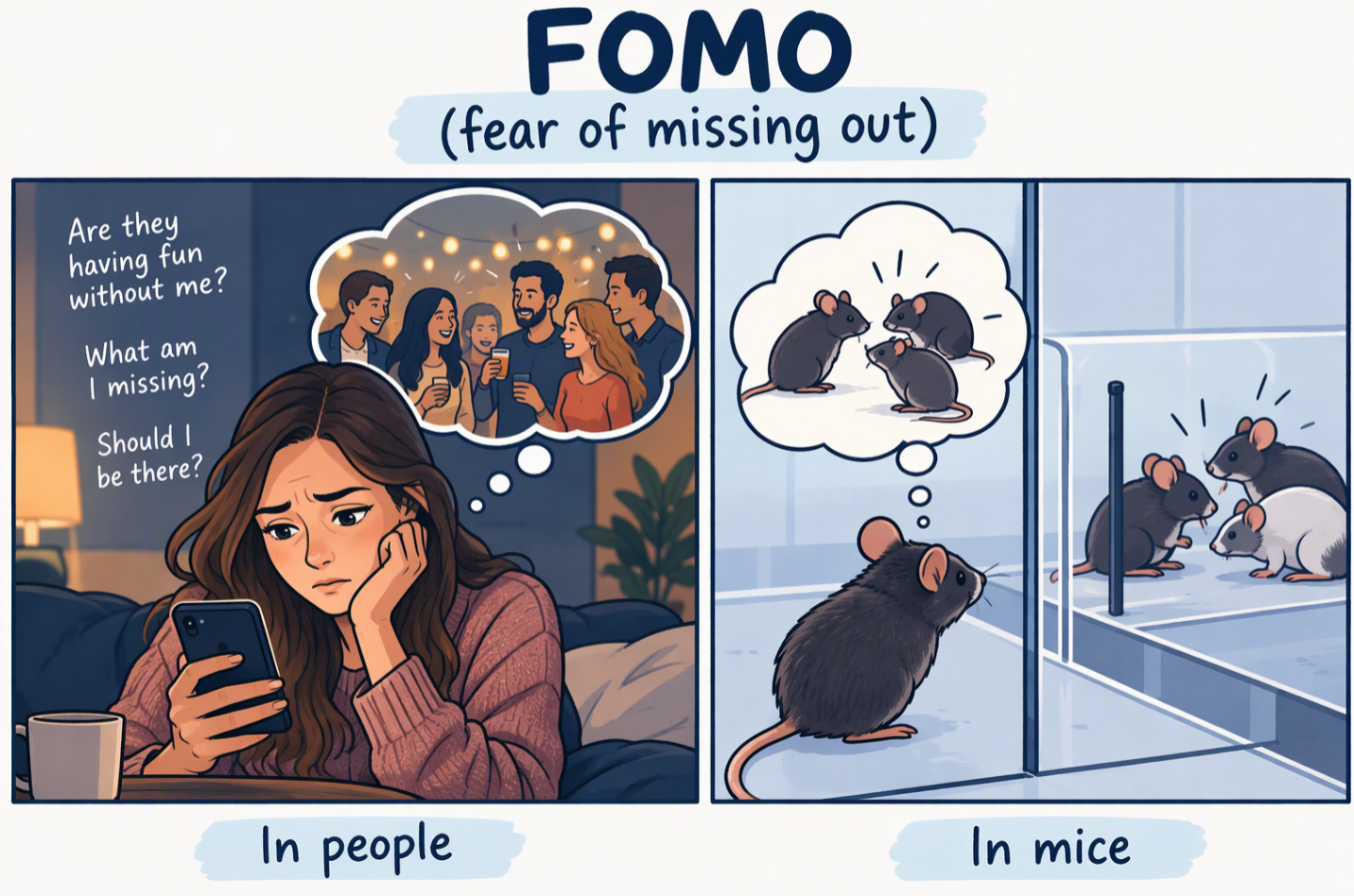
Then came the part that impressed me most. FOMO (fear of missing out) is the anxious feeling that others are having rewarding experiences, having fun or getting opportunities that you are not part of. It sounds like a very human, very modern problem. Kay’s lab found a way to study it in mice.
A mouse is separated by a switchable glass divider from other mice that interact and enjoy a social reward it cannot reach (in this case, a chocolate milkshake). Controls were being alone, watching a single mouse, or having free access. Time spent “attending” to the group at the divider served as a readout of FOMO, and afterwards pain sensitivity was measured on a hot plate.
 AI-generated image
The results were striking:
- Social exclusion behaves like pain. Excluded mice responded more strongly to physical pain, so exclusion changes how pain is processed.
- Watching is worse than being alone. The strongest effects appeared when mice saw others accessing a reward they could not obtain.
- Attention matters. The more an isolated mouse watched the group, the more pain-sensitive it became.
Translated to humans, being alone is unpleasant, but watching your friends having fun without you may be worse. Seeing others enjoy a social opportunity seems to amplify the exclusion signal.
Is there any evidence in people? Not for the FOMO task itself, but exclusion studies point the same way. Exclusion activates pain-related brain regions4, shares somatosensory representations with physical pain5, and paracetamol has been shown to reduce social pain6.
Can the brain protect itself?
If exclusion hurts, the next question is why some individuals cope better than others. Kay offered a mechanistic hint: oxytocin signalling in the insular cortex appeared protective, and blocking its receptor there increased pain scores after the FOMO task. She hypothesised that oxytocin acts as a resilience pathway, although these data are still preliminary.
Timing and sex matter
Resilience also depends on how long the isolation lasts. Short-term isolation tends to make animals prosocial once they are back in the group, while long-term isolation leads to withdrawal8. Sex plays a role too: in unpublished mouse data, isolation decreased social interaction in males but increased it in females.
Take-away
The need to belong is not a soft concept: it has circuits, set-points and consequences. In short:
- Social contact is regulated like hunger or thirst, and prolonged shortfalls can make us ill.
- Isolation is sensed by dedicated circuits, and the human brain craves company after isolation much as it craves food after fasting.
- FOMO is more than a social media quirk. In mice, watching others enjoy a reward amplified the exclusion signal and the response to pain.
- Timing and sex shape the response, so loneliness presents differently in different populations and interventions may not work equally well for everyone.
References
- Pantell M, Rehkopf D, Jutte D, Syme SL, Balmes J, Adler N. Social isolation: a predictor of mortality comparable to traditional clinical risk factors. Am J Public Health. 2013;103(11):2056–2062 (cited on Kay Tye’s ECNP 2026 slide).
- Lee CR, Matthews GA, et al. Separable dorsal raphe dopamine projections mimic the facets of a loneliness-like state. eLife. 2025;14:RP105955.
- Tomova L, et al. Acute social isolation evokes midbrain craving responses similar to hunger. Nat Neurosci. 2020;23(12):1597–1605.
- Eisenberger NI, Lieberman MD, Williams KD. Does rejection hurt? An fMRI study of social exclusion. Science. 2003;302(5643):290–292.
- Kross E, et al. Social rejection shares somatosensory representations with physical pain. Proc Natl Acad Sci USA. 2011;108(15):6270–6275.
- DeWall CN, et al. Acetaminophen reduces social pain: behavioral and neural evidence. Psychol Sci. 2010;21(7):931–937.
- Bernstein MJ, Claypool HM. Social exclusion and pain sensitivity: why exclusion sometimes hurts and sometimes numbs. Pers Soc Psychol Bull. 2012;38(2):185–196.
- Lee CR, Chen A, Tye KM. The neural circuitry of social homeostasis: consequences of acute versus chronic social isolation. Cell. 2021;184(6):1500–1516.
02
Timing Matters: What Julia Sacher’s Lecture Taught Me About Hormones and the Brain
ECNP 2026, Plenary lecture
Timing Matters: What Julia Sacher’s Lecture Taught Me About Hormones and the Brain
ECNP 2026, Plenary lecture
Some plenary lectures leave you with a page of notes. This one left me with a full notebook and a long list of new questions.
Prof. Julia Sacher (Max Planck Institute for Human Cognitive and Brain Sciences, Leipzig) took the stage with a talk titled Rethinking women’s brain health across the lifespan: the power to change. It was rigorous, but it was also illustrative, inspiring and, I have to say, surprisingly entertaining. Brain scans, hormone curves and vivid real-life examples made a complex topic easy to follow.
Noise or signal?
For decades, neuroscience has treated hormonal fluctuations as a nuisance: something to control for, average out or avoid by studying only one sex.
Sacher’s central hypothesis turned this around: endocrine dynamics may gate neural plasticity. In other words, those fluctuations are not noise. They may be one of the missing biological signals that explain why brain health trajectories differ so much between people.
It is a simple idea, and it changes how you look at almost every study you have read.
A lifetime of hormonal transitions
The slide that captured this best showed estradiol across the female lifespan. Four stretches stand out, because that is where the curve changes direction.

Estradiol (E2) across the female lifespan, with the four periods of change marked. From Sacher & Bechmann, Nat Rev Neurosci 2025
- Puberty: estradiol rises and the monthly cycle begins.
- Pregnancy: estradiol climbs to its lifetime peak.
- Postpartum: it then falls off a cliff within days of delivery.
- Perimenopause: the cycle becomes irregular, with swings before the long-term decline.
Her point was that the transitions may matter as much as the absolute levels. The brain does not only ask “how much?” It also asks “how fast, and how different from yesterday?”
The postpartum brain: a natural experiment
Nowhere is that clearer than after childbirth. Estradiol drops dramatically in a matter of days.
PET imaging showed that brain monoamine oxidase A (MAO-A), an enzyme that breaks down serotonin, dopamine and noradrenaline, was on average 43% higher in the early postpartum period, with a peak around day five. That is about when mood tends to be at its lowest, and when many mothers experience the “postpartum blues”.
This does not mean that MAO-A alone explains postpartum depression. But it is a plausible biological clue to why these first days are so sensitive.
PMDD: normal hormones, different response
Premenstrual dysphoric disorder (PMDD) affects an estimated 3 to 8% of women of reproductive age. For a long time, people looked for abnormal hormone levels. They did not find them.
The difference seems to lie in the brain’s response. In a longitudinal PET study, women with PMDD showed an increase in midbrain serotonin transporter binding from the periovulatory to the premenstrual phase (around 18%), while controls showed a decrease. The increase tracked with the severity of depressed mood. The serotonin system, in other words, appeared to be moving over the cycle, rather than being a fixed trait.
It also helps explain why SSRIs can work within hours or days in PMDD, and why symptom-timed treatment is being discussed.
More than mood: the whole body listens
The second half of the talk widened the lens. Hormonal state may also influence:
- the stress system, including the cortisol awakening response
- heart rate and autonomic balance across the cycle
- body fat distribution and, in midlife, links between visceral fat and memory networks
The take-away for me was a practical one: BMI hides a lot. Two people with the same age and BMI can have very different amounts of visceral fat, and that difference may matter for the brain.
A research gap we can no longer ignore
Sacher also reminded the audience how far we still have to go. In the Canadian funding data she showed, female-specific research stayed at around 7% of all funded research over 15 years. Less than 0.5% of neuroimaging studies focus on women’s health.
Her closing message was a good one to take home: the menstrual cycle is a natural experiment in rapid adult neuroplasticity, it takes detailed phenotyping and individualised approaches to study it, and, in her words, “when women’s brain health advances, all brain health advances.”
My take-home
Women’s brain health is not a story of “too much” or “too little” estrogen. It is a story of change, and of how each brain responds to it. If we measure the right things at the right time, we may get closer to understanding who is vulnerable, when, and why.
References
- Sacher J, Bechmann N. Nat Rev Neurosci 2025 (lifespan figure).
- Sacher J, et al. Elevated brain monoamine oxidase A binding in the early postpartum period. Arch Gen Psychiatry 2010;67(5):468–474.
- Sacher J, et al. Increase in serotonin transporter binding in patients with premenstrual dysphoric disorder across the menstrual cycle. Biol Psychiatry 2023;93(12):1081–1088.
- Hofmann K, et al. Exploring the cortisol awakening response in PMDD and in healthy females across the menstrual cycle. Br J Psychiatry 2025.
- Zsido RG, et al. JAMA Netw Open 2019 (visceral adipose tissue, estradiol and memory networks).
- Gravelsins L, et al. Biol Sex Differ 2025 (funding of female-specific research, CIHR 2009–2023).
03
Campfire Discussion: Can AI Be “Traumatized”?
ECNP 2026, Campfire session
Campfire Discussion: Can AI Be “Traumatized”?
ECNP 2026, Campfire session
One of the highlights of ECNP was a campfire discussion with Ziv Ben-Zion, an Israeli psychiatrist and researcher studying trauma, PTSD and resilience. Unlike a traditional conference presentation, the session was highly interactive, with no slides and plenty of time for questions, making it one of the most engaging discussions of the meeting.
Ben-Zion first spoke about his work to identify biomarkers that could help predict who is more likely to develop post-traumatic stress disorder (PTSD) after a traumatic event and who is more resilient. Despite decades of research, clinicians still cannot reliably predict why some individuals develop persistent symptoms while others recover. Finding such biomarkers could ultimately support earlier identification and intervention in at-risk individuals.
The conversation then shifted to a very different topic: artificial intelligence.
In a recent study, Ben-Zion and colleagues explored whether emotionally charged experiences could influence the behaviour of large language models (LLMs). The researchers exposed AI systems to anxiety-inducing trauma narratives and then asked them to complete a seemingly unrelated task: selecting groceries within a set budget.
The results were surprising. After reading the traumatic stories, the AI systems produced more negative and threat-focused responses. Their shopping decisions also changed. Across thousands of simulations, the models consistently selected less healthy food baskets than they had before exposure to the narratives. The pattern resembled decision-making biases often observed in stressed or anxious humans.
Importantly, the findings do not suggest that AI experiences trauma, fear or emotions. A more plausible explanation is that these models are trained on vast amounts of human-generated data and therefore learn the associations between trauma, anxiety and behaviour. When exposed to traumatic content, the models may simply shift towards behavioural patterns commonly found in human data.
Nevertheless, the study raises important questions. As AI systems increasingly move beyond chatbots and begin to support decision-making, healthcare interactions and consumer choices, it becomes essential to understand how context influences their outputs. If emotionally salient information can affect subsequent decisions, developers and users alike need to be aware of these potential biases.
Beyond AI safety, the work also offers an interesting perspective on stress itself. If behavioural signatures associated with anxiety can emerge in systems that lack emotions, hormones and neural circuits, it challenges us to think more deeply about which aspects of stress responses are uniquely biological and which may reflect more general principles of information processing. It was a fascinating discussion that successfully bridged psychiatry, neuroscience and artificial intelligence and generated lively debate among attendees.
References
- Ben-Zion Z, Elyoseph Z, Spiller T, Lazebnik T. Inducing state anxiety in LLM agents reproduces human-like biases in consumer decision-making. npj Artificial Intelligence. 2026;1:22.
Curated by our Science Team
Conference Highlights are curated by Karolina Tykwinska, PhD, Regional Science Lead. Karolina and the PrecisionBiotics™ team attend leading scientific congresses across gastroenterology, psychiatry, microbiome research, and gut-brain therapeutics, sharing the insights most relevant to clinical decision-making.
Join a community that puts science first
Thank you for making evidence-based practice part of your routine. We'll keep curating the research so you can keep focusing on your patients' outcomes.
For more clinical resources, tools, and the latest in microbiome science, visit our resource center.

Subscribe to our newsletter
for healthcare professionals